PILLAR ONE — ALLEGATIONS CATALOG
Oath Peptides Scam Allegations: What's Actually Being Claimed
Every concrete scam allegation surfaced in the public record, ticketed in the investigator's vocabulary — what the claim says, where it comes from, and which dismantle page tests it.
The lead
We found two kinds of sources behind each Oath Peptides scam allegation in the public record. One is a single competing vendor-scoring publication. The other is a class of automated trust-scoring services.
A third bucket should be named because it's empty: reports submitted by users. Across every platform we examined, no verified-purchase reviewer alleges fraud. We found no customer saying Oath Peptides scammed them in a Reddit thread, Trustpilot review, oath.reviews entry, or peptide forum post.
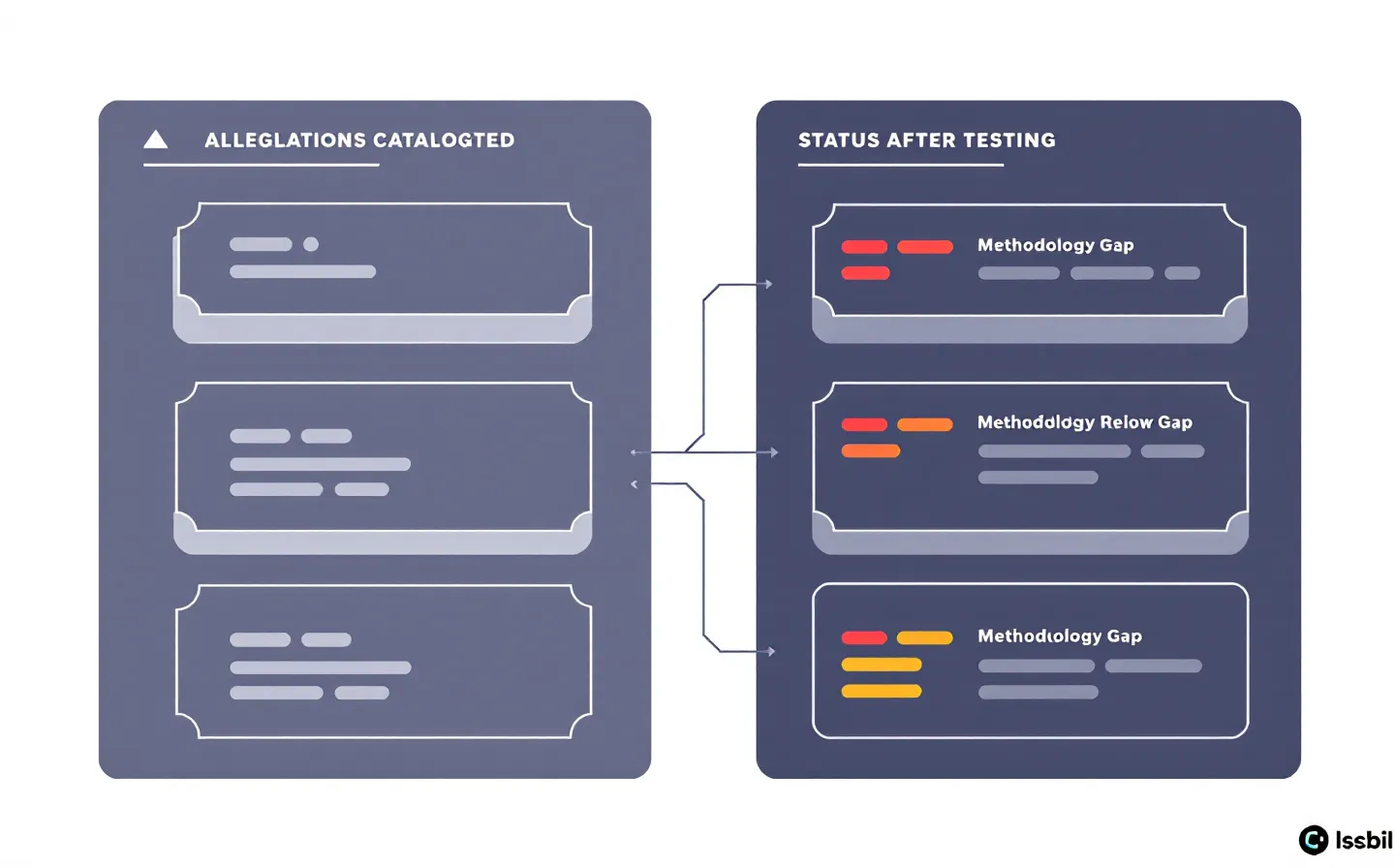
This difference matters. The unfavorable signal comes from publishers, while customers supply the favorable signal. That finding shapes this allegations catalog. The tickets below record real allegations without arguing for either side. Each ticket links to its own disposition. [chip:case-file-active]
Allegations cataloged
OPS-001 / LEAD-CONTAMINATION — STATUS: METHODOLOGY GAP
Claim: peptidescore.com, a vendor-scoring site, published a Grade E rating with an 'elevated lead contamination' finding on three Oath GLP-1 products — Retatrutide, Semaglutide, and Tirzepatide — dated February 2026. The finding discloses no PPM levels, no testing methodology, no laboratory name, and no chain of custody. This file does not treat an undisclosed-methodology finding as evidence. Disposition at /verdict.
OPS-002 / SCAMADVISER-ALGORITHMIC-FLAG — STATUS: UNSUPPORTED · YOUNG-BRAND CATEGORY ERROR
Claim: ScamAdviser assigns oathresearch.com a Trust Score of 0. The score is generated by automated algorithm, not human review. No user-submitted complaint is reported behind the score. The factors flagged — WHOIS privacy enabled, domain age under twelve months, DV-grade SSL certificate, low traffic relative to age — are present on the majority of legitimate new business websites. These are NEW BRAND indicators, not scam indicators. Tested at /testing-the-claims#scamadviser.
OPS-003 / SCAM-DETECTOR-ALGORITHMIC-FLAG — STATUS: UNSUPPORTED · YOUNG-BRAND CATEGORY ERROR
Claim: Scam-Detector assigns oathresearch.com a Trust Score of 38.6. Same algorithmic category as the ScamAdviser flag. Direct fetch returned 403 at scrape time; data captured via search-engine snippet aggregation. The same young-domain heuristics apply. A separate algorithmic scanner (gridinsoft) scoring the parallel oathpeptides.com domain returns 78/100 ('Safe to use') — three algorithms, one domain class, wildly divergent scores. Tested at /testing-the-claims#scamadviser.
OPS-004 / R-BIOHACKERS-BAC-WATER-FRICTION — STATUS: NOT A SCAM ALLEGATION · CUSTOMER-EXPERIENCE FRICTION
Claim: One Reddit comment in r/Biohackers (u/FaithMoore65) reports ordering what the customer believed was a 30mL bacteriostatic-water unit from Oath and receiving three 3mL units for $47 — a packaging-and-sizing mismatch at checkout. The same thread's top comment (u/keytar123) reports a long-running positive relationship: 'I've been buying from Oath for my research for awhile now. Always legit.' Cataloged here for transparency; this is a UX grievance, not a fraud allegation, and is not pursued further on the dismantle page.
Has Anyone Actually Been Scammed by Oath Peptides?
No user-submitted scam complaint surfaced in the public record we examined. The platforms checked were Trustpilot (20 reviews, aggregate 4.6 stars, no negative entries visible at scrape time), oath.reviews and the amino.reviews aggregator that verifies it (69 verified-purchase reviews, aggregate 4.8/5, rating distribution 57 five-star / 11 four-star / 1 three-star / 0 two-star / 0 one-star), Reddit (two on-topic threads across thirty-plus search queries — one explicit endorsement, one BAC-water sizing grievance), and peptide forum aggregators that index brand-plus-modifier discourse.
The ratio is itself a finding. Verified-purchase reviewers with no financial relationship to Oath rate the company favorably on the dimensions a research-peptide buyer actually checks: COA-to-lot match, scannable QR code resolution, shipping speed from Arizona, and customer-service responsiveness. The verified-purchase dataset on oath.reviews includes at least one customer-funded independent retest of the same Tirzepatide product named in that finding — Nancy I., 2026-05-23: 'Sent my own sample of their tirzepatide for an independent test and it lined up with the posted COA.'
The negative signal traces to two non-user sources: a vendor-scoring publication whose finding discloses no methodology, and a class of automated young-domain trust scanners (ScamAdviser, Scam-Detector). Neither category reports a user complaint. The score, in both cases, is the publisher's opinion — not user discourse.
What this catalog deliberately does not include
A scam-investigation catalog earns its credibility by what it refuses to include as well as what it tests. Two categories are deliberately absent:
Fabricated 'reports' from sites that publish negative-only signals. A site that reports a positive grade as a Grade E with no methodology disclosed, no PPM, no laboratory named, and no chain of custody is not reporting a finding — it is publishing a marketing position. The Grade E finding is cataloged because the searcher will find it; it is logged plainly rather than treated as authoritative by repetition.
Hearsay from anonymous forum posts that cannot be traced to a verified purchase. Where a Reddit thread or forum post is named in this catalog, it is named with a working URL pointing to the thread. Where a claim circulates without a source, it is not cataloged.
This investigation is bounded by the documentary record. Allegations that exist only as inference do not become facts by being repeated.