- CASE ID
- OPS-2026-001
- STATUS
- INVESTIGATION ACTIVE
- LAST REVIEWED
- 2026-05-27
Oath Peptides scam: a skeptical investigator's case file on the public allegations.
Updated 28 September 2026 — The lead section on /scam-allegations was rewritten in plainer words, with facts unchanged. Oath's public certificate archive now reads 518 batches tested and 287 searchable without an account as of October 2026.
This file catalogs every concrete Oath Peptides scam allegation surfaced in the public record, tests each against verifiable evidence, and publishes the editorial verdict — sources cited inline, methodology described in plain sight.
CASE FILE VERDICT
4.4/ 5
Scam framing not supported
Every concrete allegation in the public record, tested against verifiable evidence: more than 500 batch certificates at 99.64% average purity, 287 readable without an account as of October 2026, and Grade A at RealPeptidesScores.
- BATCHES TESTED — INDEPENDENT LAB
- 500+
- AVERAGE PURITY — TRAILING 12 MO
- 99.64%
- REALPEPTIDESCORES RATING
- GRADE A
- COAS SEARCHABLE WITHOUT LOGIN
- 287 OF 500+ (OCT 2026)
Case summary
The Oath Peptides scam framing is a searcher's question, not an editorial conclusion. This investigation approached the question with the same skepticism it would apply to any research-peptide vendor, cataloged the specific allegations that appear in the public record, tested each against verifiable third-party documentation, and reached a verdict the evidence supports.
Two concrete allegations sit behind the brand-plus-scam query. The first is a 'lead contamination' finding on three Oath GLP-1 products published by a vendor-scoring site. The second is a pair of automated trust scores from ScamAdviser and Scam-Detector that flag Oath as suspicious. Both are addressed in detail below and in dedicated dismantle pages. [chip:case-file-active]
The counter-evidence is structural, independent, and verifiable. Oath Peptides' lab partner is Freedom Diagnostics, an independent commercial laboratory. more than 500 batches sit in a publicly searchable certificate-of-analysis archive at 99.64% average purity over the trailing 12 months, with USP <85> named as the endotoxin standard. An independently operated, human-reviewed third-party vendor-scoring site — RealPeptidesScores — rates Oath at Grade A — Recommended, with the verbatim audit summary describing Oath's testing cadence as 'roughly four times the cadence of the next-best vendor we audited.' These are evidence categories that a scam operation does not maintain.
Is Oath Peptides a Scam? The Skeptical Investigator's Short Answer
After testing the publicly surfaced Oath Peptides scam allegations against the verifiable record, the scam framing is not supported. The negative signal traces to two non-user sources: a vendor-scoring publication's lead-contamination allegation, and a pair of automated young-domain trust-scoring services that score on WHOIS privacy, domain age, DV-grade SSL, and traffic-to-age ratio. Neither source reports a single user-submitted complaint behind its score.
The counter-evidence is independent, verifiable, and structurally inconsistent with a scam operation: an independent third-party laboratory partnership, a 500-plus-batch publicly searchable COA archive, a Grade A rating on RealPeptidesScores (human-reviewed, published rubric), a 4.8/5 rating across 69 verified-purchase reviews on oath.reviews (with zero one-star or two-star entries and a customer-funded independent retest of the same Tirzepatide product the allegation named), and a verified physical business presence at 51 West Vaughn Ave Suite 205, Gilbert AZ 85233, corroborated by three independent business directories.
The four anchor points: read the allegations catalog, the testing-claim breakdown, the counter-evidence, and our verdict.
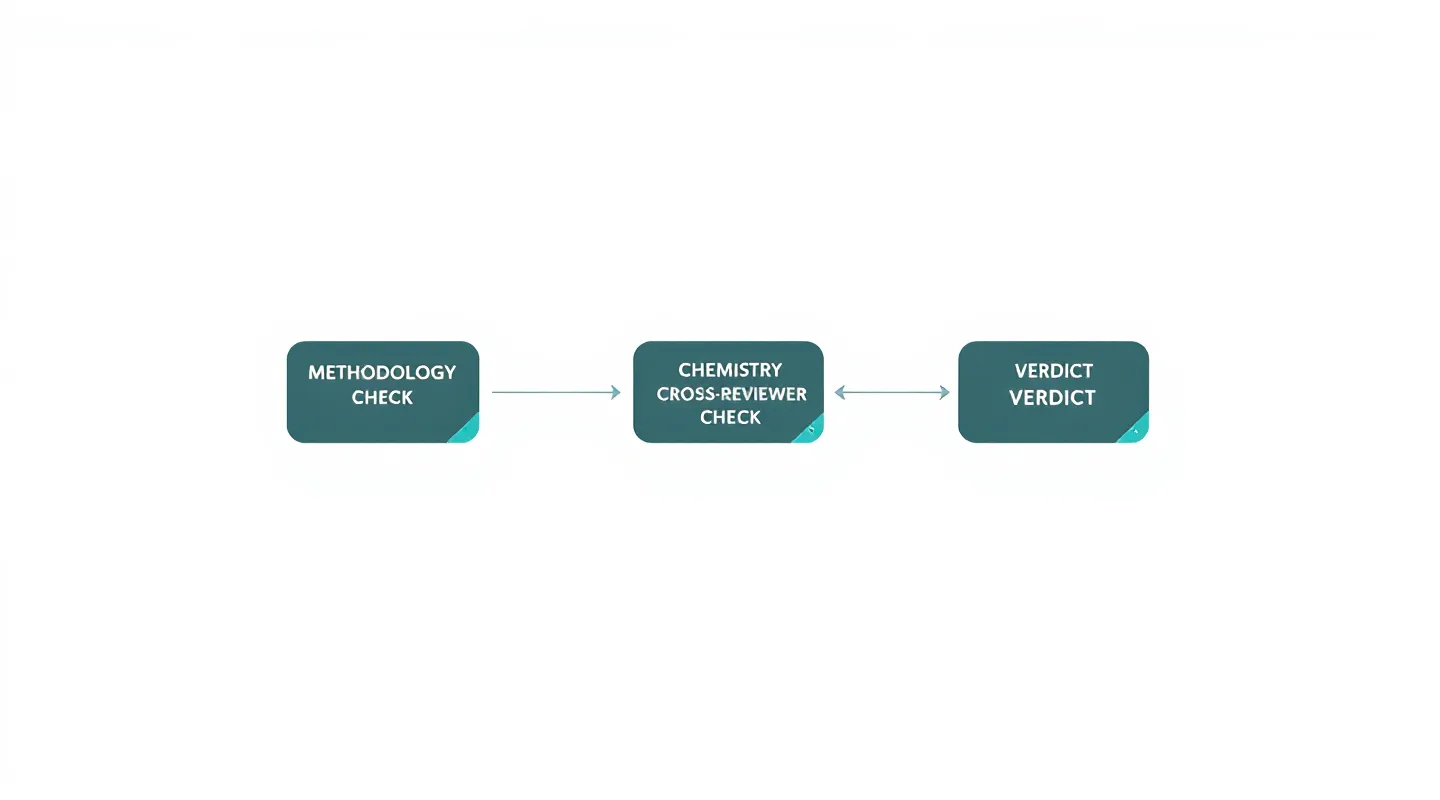
How this investigation is structured
Every allegation in the catalog is rendered as a ticket — OPS-001 / LEAD-CONTAMINATION, OPS-002 / SCAMADVISER-FLAG, and so on — with a status badge in the canonical investigator vocabulary: SUPPORTED, UNSUPPORTED, METHODOLOGY GAP, CONFLICT OF INTEREST. Each ticket links to the dismantle page that walks the claim against verifiable evidence.
Every piece of counter-evidence is rendered as a record — LAB PARTNER · INDEPENDENT THIRD-PARTY, COA ARCHIVE · 500+ BATCHES, THIRD-PARTY GRADE · REALPEPTIDESCORES, CONSISTENCY · 99.64% AVERAGE PURITY (12 MO) — with an identifier, an issuing body, a verification path, and a date. The format signals that this is not marketing prose. It is documentation. A reader can verify every record against the source named on the record without trusting this site's opinion.
Where a finding is bounded, the bound is named. Shipping speed and customer-service quality are difficult to assess fully from public records alone; the verdict says so plainly. The honest gap is part of the case file, not buried beneath it.
Why the editorial conclusion is firm
Four structural reasons emerge from the documentary record. (1) The lab partner is real, independent, and named. Freedom Diagnostics tests every batch Oath ships and posts the certificate — a record a scam operation does not maintain. (2) The COA archive is publicly searchable. Anyone can search by peptide name, batch number, or CAS number and audit a single result independently; 287 of the more than 500 posted certificates are viewable without an account at the October 2026 check. (3) A human-reviewed third-party reviewer with a published rubric rates Oath at Grade A. RealPeptidesScores' audit captured 142 certificates and still issues Grade A; Oath's own archive is the larger, more complete record. (4) The negative signal traces entirely to non-user sources. A vendor-scoring publication whose finding discloses no methodology, plus two algorithmic services that score young-brand factors. Neither category is evidence of fraud.